
Malden City Directory Collections
The Malden Public Library holds the deepest local shelf. Its local-history collection reports city directories spanning 1869 through 1985. Some issues are missing, and publication was irregular. Publishers changed hands over that run too. The library's research guide traces Polk's Malden City Directory back to 1869. The State Library keeps its own run. It is selected and noncontinuous. So its list does not prove that every volume survives there or at the Malden Library. Treat the local collection, the State Library inventory, and selected Boston Public Library or genealogy-database runs as complementary stops. One of them may cover whatever year goes missing.
| Collection | Years | Where Held | Access |
|---|---|---|---|
| Malden city directories | 1869-1985, missing issues | Malden Public Library local history | In person; appointment recommended; materials do not circulate |
| Polk's Malden City Directory | Begins 1869 | Malden Public Library research collection | Local-history consultation |
| State Library selected Malden run | 1869-1980, selected issues | Massachusetts State Library | Confirm catalog, shelf, and issue condition with reference staff |
| List of Persons and poll books | Begins 1884 | Malden Public Library local history | In-person historical roll |
| Selected directory images | Selected years, not a complete run | Genealogy databases and libraries | Access can require library service |
The State Library's selected sequence is exact: 1869; 1870-71; 1872-73; 1874-75; 1876-77; 1880; 1882-88; 1890-93; 1895; 1897; 1898*; 1900*; 1902*; 1904*; 1906*; 1908*; 1909-10*; 1911-12*; 1913*; 1914*; 1916*; 1917*; 1919*; 1921*; 1924*; 1925*; 1927*; 1929*; 1932*; 1934*; 1935-36*; 1937-38*; 1939*; 1941*; 1943*; 1945; 1958*; 1962*; 1963*; 1965*; 1966*; 1967*; 1969*; and 1980*. That is a long list. The run is far from continuous. Whole decades show up only in scattered years. Those asterisks matter too. They come from the State Library PDF and mark catalog condition or format, not a promise of uniform access. Confirm the specific issue before a trip.
Note: Record a missing directory year as a gap rather than assuming the same household stayed at the same address.
Malden Library Desk Tactics
The Malden Public Library keeps local-history material in the Converse Memorial Building. Appointments are welcomed and encouraged. Bring pencils; the library bans ballpoint pens around the collection. Directories, poll books, yearbooks, and other fragile material generally cannot be photocopied or removed. Newspaper microfilm prints are allowed. Wednesday is the recommended local-history day. A research request can take about two weeks or longer. Volume and staffing often drive that timeline. Call (781) 324-0218 or email the librarian before counting on a same-day consultation. Check the Malden Public Library local-history collection before you plan a visit.
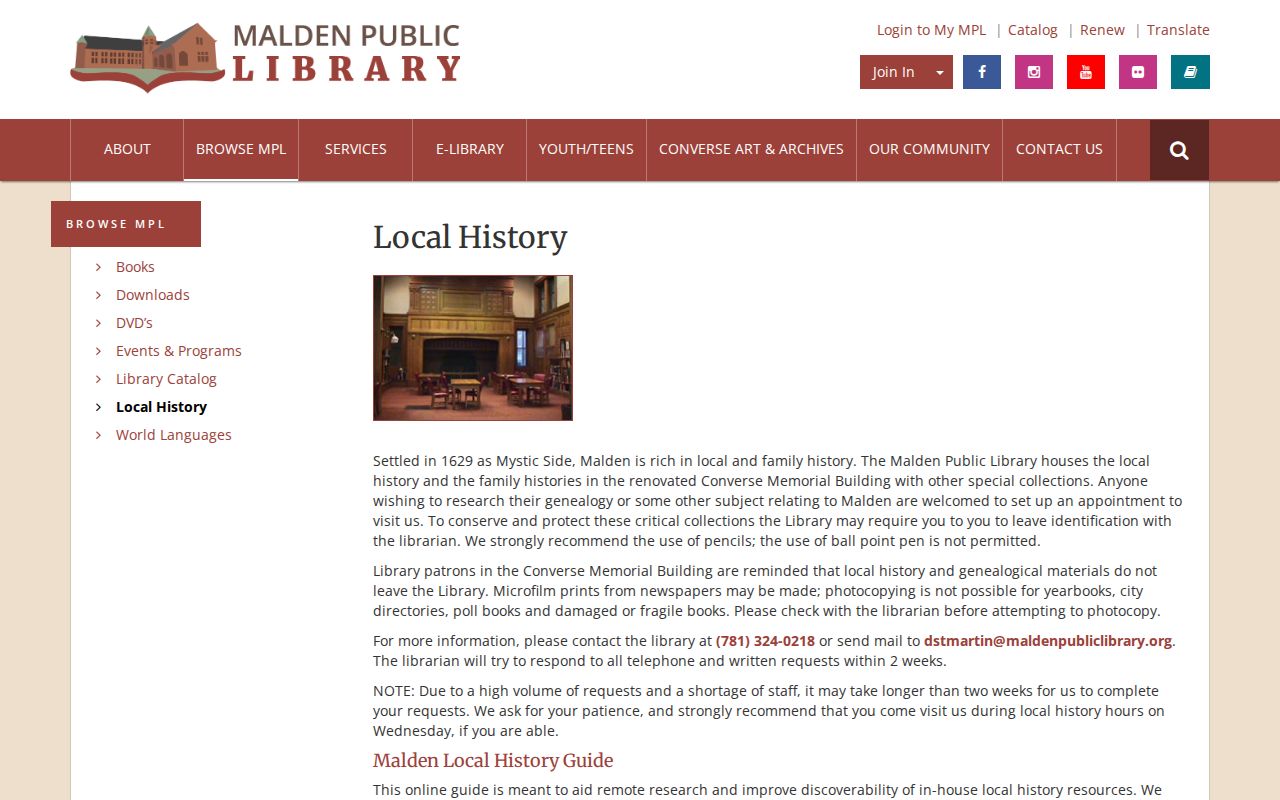
The collection reaches beyond the directory shelf. Poll books, vital-record compilations, newspapers, and maps sit nearby, ready when a directory entry alone runs thin.
Malden Polk Name Routes
Polk's Malden City Directory is a rich name route. It can identify adult residents, businesses, home or business owners, marital status, occupation, address, and business personnel. Where the feature appears in the volume at hand, its reverse lookup runs from address to occupant. The List of Persons, added in 1884, works differently. It reads like a local annual census. Entries run by ward, precinct, street, and house number, with an alphabetical index at the back. For anyone age 17 or older, it can add occupation, birth year, and voting status to the location. Early volumes lack street indices. For 1869 through 1890, go name-first. Then test the location with the printed address, nearby names, ward order, and maps. Street searching stays indirect. Check a volume's own reverse or street material rather than presuming it from another year. The Malden Library research guide covers both tools first.
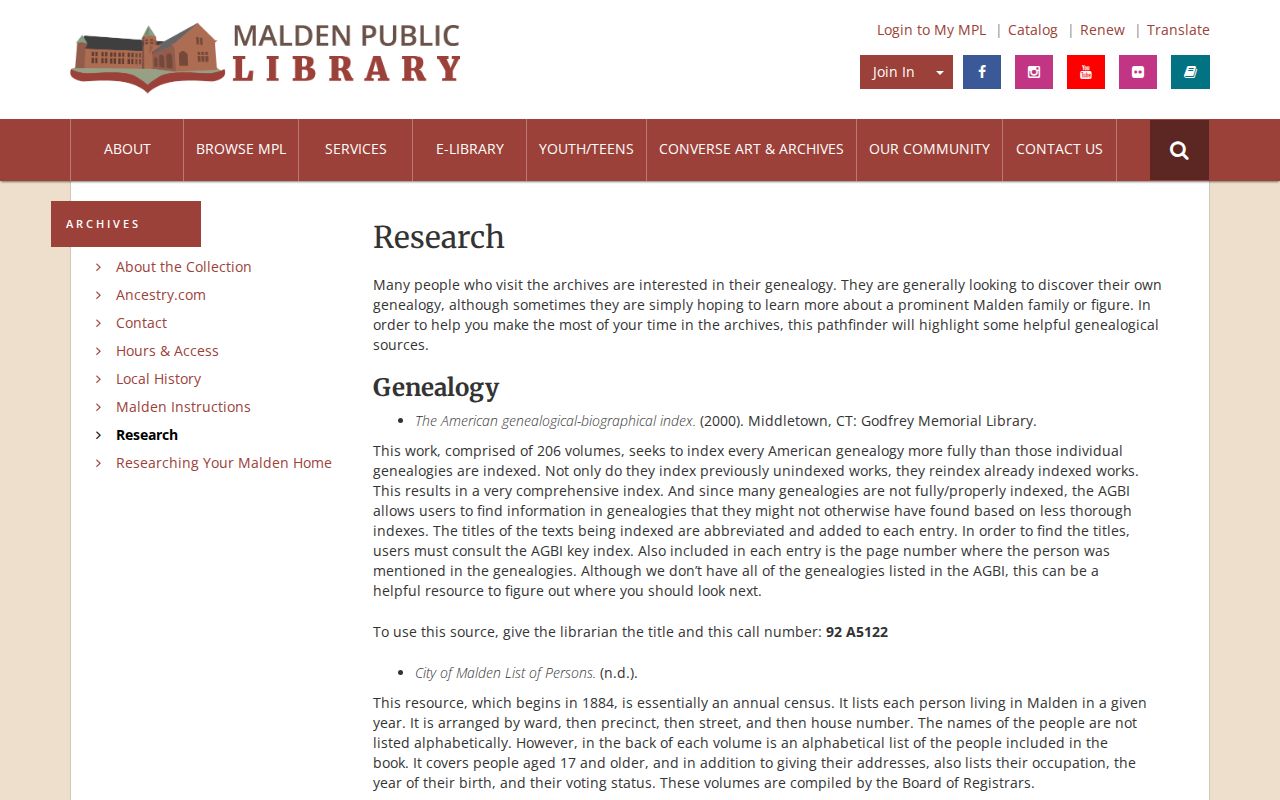
It earns its keep at the fork in the road. Use it to pick the name-first path for the early years and the ward-and-street path for the List of Persons volumes.
Reading Malden City Directory Entries
Think of a Malden entry as an identity bundle, not proof. Copy it exactly as printed. Initials and punctuation carry weight. Normalize the name only after transcribing the source wording. Polk's description supports adult names, marital status, occupation, address, owner or business clues, and business personnel, the List of Persons adds its own fields, and a faithful transcription preserves both for later comparison.
| Exact name | Spelling, middle initial, suffix, and any name variant printed in the volume. |
|---|---|
| Marital notation | Marital or widow notation where the particular entry supplies it. |
| Occupation | Occupation and employer or business personnel detail when printed. |
| Address | House number and street, recorded exactly as the volume gives them. |
| Ownership clue | Home-owner, business-owner, or other printed status clue only where the consulted run supplies one. |
| Cross-reference | Street spelling, nearby entries, and a house-guide or List of Persons reference when available. |
- Criss-cross directory
- An address-ordered section that can connect a street and house number to listed occupants when the consulted volume includes it.
- Householder index
- An alphabetical finding aid for locating a named household before turning to a street, ward, or precinct entry.
- Abbreviation key
- A legend that must be read in the actual volume if present. The research does not establish one universal Malden key for every publisher.
Malden Directory Access Limits
A directory is not a census of an address. Treating it as complete is a mistake. Polk covers adult residents and business information. The List of Persons uses a different age threshold. Someone can vanish for many reasons. Coverage, the reporting date, a move, a spelling change, or a missing issue can all leave a blank. The library reports gaps in its run openly. A blank result is a cue to widen the search, not to invent continuity. Poll books from 1884 add a voting-age layer, but their street indexes only appear in the 1930s. For older address work, lean on the List of Persons back index, ward and precinct order, the directory name route, and map context. Modern voter-status tools exist for an individual self-check and cannot replace these historical materials.
Malden Directory Companions
A Malden city directory entry says more on its own. But it says even more beside the library's other local collections. The newspaper index spans 1860-2001 across 14 Malden papers plus decades of the Boston Journal. The obituary index starts in 1973, and clipping material reaches back to the 1840s. Microfilm can date a move, a death notice, a marriage, a home sale, or a civic role. It can date any of these. Confirm any formal event with an official record, though. For land context, the 1885 and 1897 G.H. Walker atlases show lots, owners, buildings, rail lines, and street patterns. The Sanborn series adds building and lot continuity over time. Browse the Malden digitized archives for the online companion material.
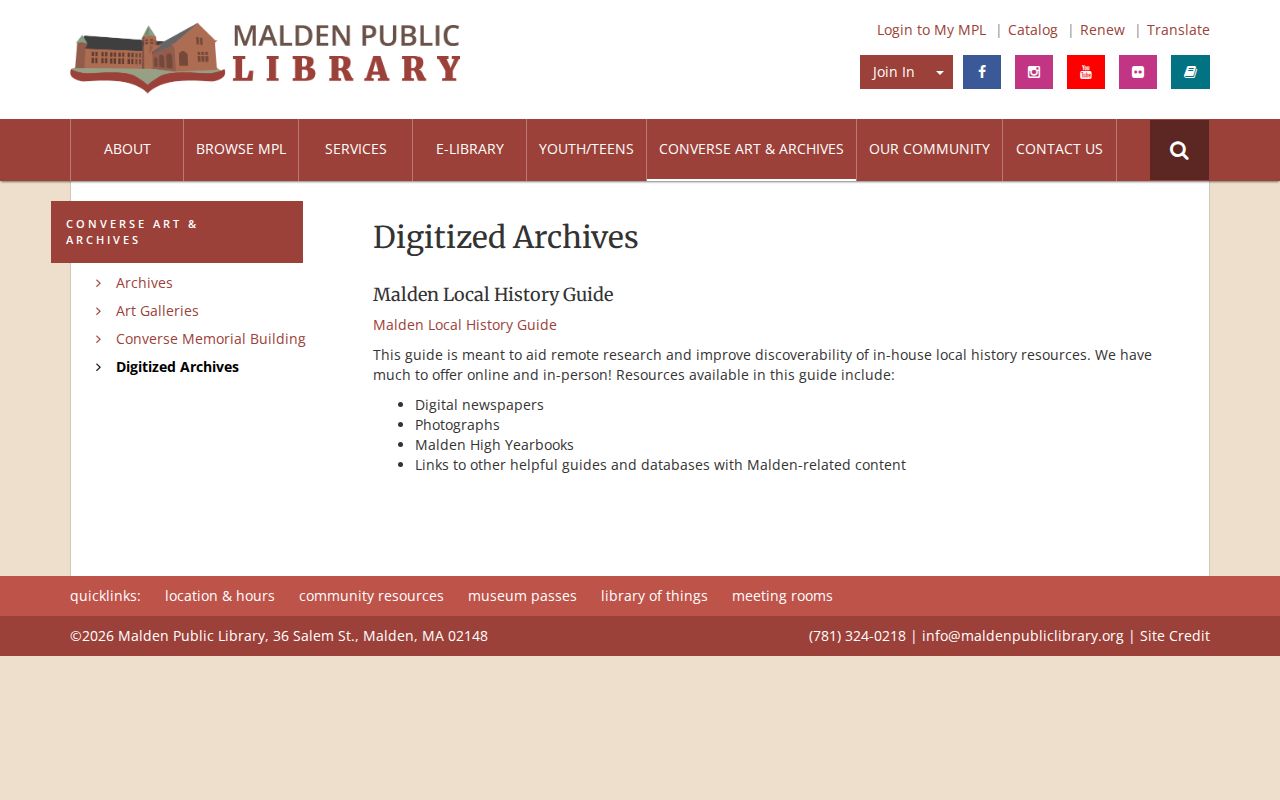
The digital collection also holds Maldonian yearbooks from 1919-2015 and Malden house-photo links. Both are handy for testing a school, address, or household clue against a directory entry.
Fragile items sometimes cannot be handled or copied. In that case, library staff may load digitized local material onto a patron flash drive on request. Card- or library-mediated genealogy and newspaper databases are available too. Selected online directory images cover particular years. But they do not form a complete Malden run, and access varies by service. When an online image is missing, unreadable, or hard to match to a physical volume, the local-history desk is the best first contact.
Earlier family trails lead to more shelves. The library holds the New England Historical and Genealogical Register, AGBI, early-settler works, cemetery material, high-school publications, and local church or club histories. These can explain a name, relationship, or community tie. A Malden residents directory only hints at such details. Keep their purpose separate from the directory's dated address evidence.
Note: Atlases and Sanborn maps are owner or building snapshots, not complete Malden household lists.
Trace Malden Directory Households
Trace households as a dated sequence. Start from the earliest confirmed name or address. Then compare the next available directory issue rather than skipping missing years. The federal census is public through the 1950 release under the 72-year rule. Malden's historical survey also flags Massachusetts state census years 1855 and 1865. Census and directory records answer different questions. Agreement on street, ward, age, household members, and occupation makes a conclusion far stronger.
- Find the first confirmed Polk or List of Persons entry and transcribe its exact name and address.
- Check the next available Malden directory issue, noting a move, occupation change, spouse notation, or disappearance.
- Use the street or reverse feature only when that particular volume provides it, and compare nearby listed names.
- Pair the closest directory years with the 1855 or 1865 Massachusetts census or the appropriate released federal census.
- Use the newspaper and obituary indexes to test whether a disappearance reflects a move, a death, or an unlisted year.
A later record may carry the same surname yet belong to someone else entirely. Keep source dates separate. Treat a change of address as a question, not a conclusion, and resolve it with a map, deed, poll book, or obituary.
Malden Directory Timeline
Malden's written resident trail is layered rather than continuous. The date sequence helps you pick the right shelf before searching a name.
- 1860: the local newspaper index begins.
- 1869: the Malden city directory and Polk line begin in the library's research description.
- 1884: the List of Persons and poll-tax books begin.
- 1930s: local poll-book street indexes begin to appear.
- 1973: the obituary index begins.
- 1985: the library's stated city-directory span ends, with missing issues within the run.
The local history collection also holds early vital records for 1649-1850, printed histories, cemetery material, high-school publications, and church and organization histories. Those sources can identify an earlier family connection. Still, they are no substitute for the dated city-directory entry being tested.