
Malden Street Directory Workflow
Begin with the street number and normalize the street suffix before searching. A present-day Malden address leads first to the City assessment card, then to the parcel on the map, not straight to a list of people. The Malden WebPro assessor database supplies the parcel, location, owner, tax mailing address, sale reference, and legal description that connect an address to land records. It is an assessment source, so an owner name or mailing address does not establish who is currently at the situs.
From there, use MapGeo to place the parcel among the street segment, ward, precinct, and adjoining lots. The deed trail comes next through Middlesex South. The statewide voter tool is only a name, birth-date, and ZIP self-check, so it cannot produce a street roster. For earlier households, the Malden Public Library’s reverse Polk directory, List of Persons, and poll books are the address-based fallback.
- Search the address in WebPro and record the parcel ID, situs, owner, mailing address, sale reference, and legal description.
- Search the same street in MapGeo, click the parcel, and compare its boundaries with the nearby parcels.
- Open the recorded deed using the book and page or the party and property fields at Middlesex South.
- Use voter information only through the individual self-check or a lawful local-list request to the Malden Registrar.
- For a past address, ask the Library for the reverse directory, List of Persons, poll books, maps, and relevant newspaper index.
Malden Street WebPro Results
WebPro is the strongest current starting point for a Malden street-by-street lookup because its whole-street result pages can be sorted parcel by parcel. The documented result columns include Parcel ID, Location, Owner, Built, Type, Total Value, Beds/Baths, Lot Size, Finished Area, land-use code, neighborhood, and sale date, price, and book-page reference. Each individual card can add zoning, assessment history, building and land detail, current property mailing address, and legal description. Blank or rear parcels deserve their own notation rather than a guess about a household.
| WebPro field | Use for a Malden street search | Important limit |
|---|---|---|
| Location / situs | Matches the parcel to the street number being researched. | A situs is the land location, not proof of present residence. |
| Owner | Provides the party to compare with a deed and prior sale. | An owner may be a trust, company, or public body. |
| Parcel ID | Connects WebPro, MapGeo, tax maps, and parcel research. | Older parcel IDs can also appear on a card. |
| Mailing address | Helps distinguish a tax correspondence address from the parcel. | It can be outside Malden or use a post-office box. |
| Book / page and sale data | Points toward the recorded transaction for verification. | A displayed transfer value needs deed-image context. |
The WebPro search identifies its current public data as the FY2025 assessment roll, based on the January 1, 2024 assessment date and 2023 sales. Assessment data is committed annually, so compare the card with a recorded deed when the timing matters.
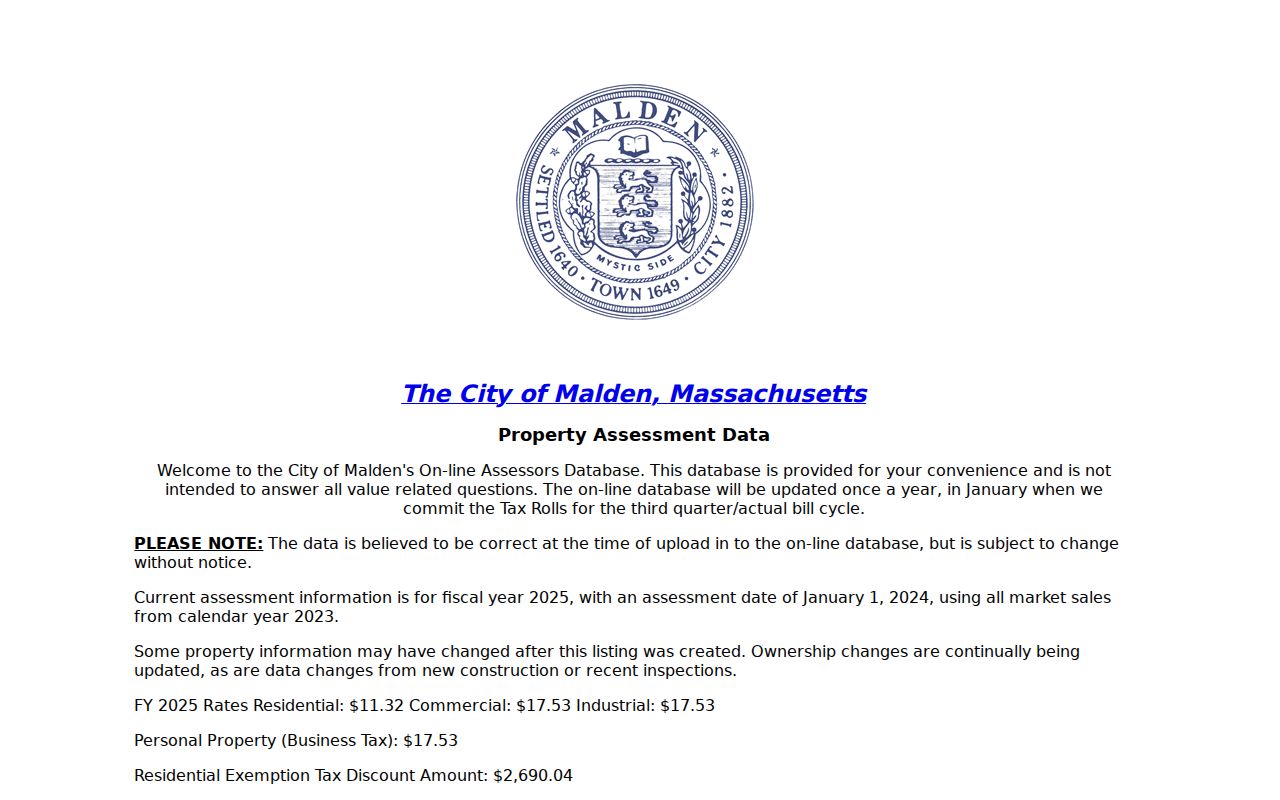
The assessor screen is useful for beginning a street-by-street parcel list, but the displayed owner and mailing fields still need to be read as tax-record fields.
Note: The assessment card is a current tax record, so preserve its assessment year when comparing it with an older deed or directory.
MapGeo Along Malden Streets
MapGeo turns a street-directory address into a parcel pattern. Its documented attribute search includes Owner, ownerName2, Parcel ID, and Street Name. Search a street name, pan to the block, select the target polygon, then inspect the polygons that share its edges. The City’s GIS material adds ward, precinct, voting-location, tax, and assessment context. That is particularly helpful where a street crosses a neighborhood edge or where an old record uses a ward or precinct instead of today’s neighborhood wording.
The map is a reference tool, not a survey. The City’s GIS page offers the Street Index Map, ward and precinct map, zoning material, and annual assessment downloads, while the 2010 tax-map street index assigns map numbers to streets. Its warning matters: the deed, rather than a GIS line, is the legal cadastral definition. Compare MapGeo with the legal description and the recorded plan before treating a boundary as final.
The Malden MapGeo parcel viewer displays the search choices used for the map stage of the address research route.
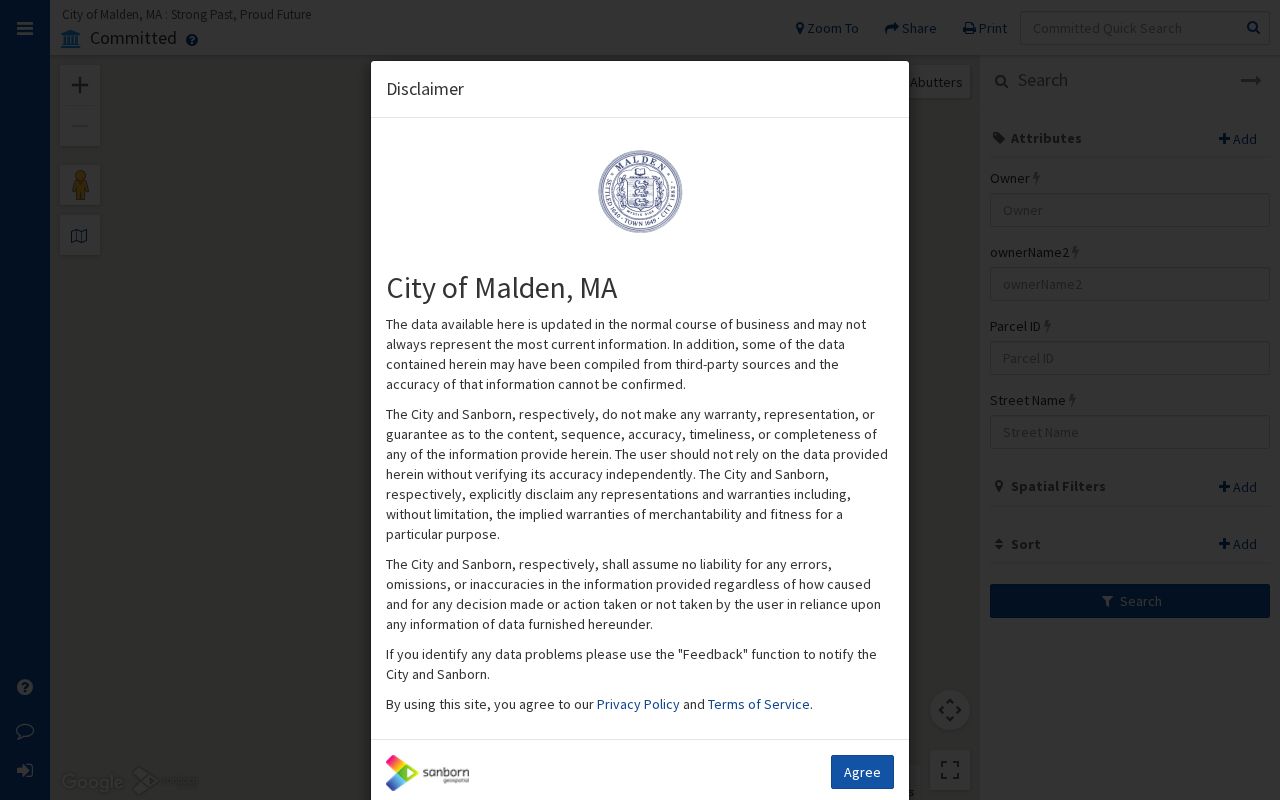
MapGeo makes adjacent parcel IDs visible for checking the geography around a number, but geographic adjacency does not establish a personal connection.
Malden Street Record Terms
Several labels must stay separate during a Malden address search. A current address can identify the building, while the land records use a parcel and legal language. Recording those separate values prevents a tax correspondence address or a simplified map label from being mistaken for the property itself.
- Parcel
- A mapped unit of land used by the assessor and GIS. Malden cards can show a current map, block, and lot-style identifier as well as an older parcel ID.
- Situs address
- The physical location of the parcel or building. It is the address used to locate land on a Malden street.
- Legal description
- The deed’s land-identifying description, often supported by lot, plan, or book-and-page references. It controls when street numbering is unclear.
- Criss-cross directory
- A reverse directory arranged to move from an address to a listed person or business. Polk’s Malden directory has this address-to-entry function.
These terms also help with a parcel split or a changed street number. The old parcel ID, map lot, and legal description can preserve continuity when a simple number search fails.
Malden Address Record Coverage
Different Malden records answer different address questions. The following sources are keyed to the property or can be used with a specific address. None of them forms a complete list of everyone at a street number. Reading their limits together is more reliable than treating any single search screen as a resident roll.
| Malden record | Address key | What it establishes | Access channel |
|---|---|---|---|
| WebPro assessment card | Situs, owner, parcel ID | Tax owner, mailing address, sale references, and assessment details | Free WebPro search; Assessors office or public-record request |
| MapGeo parcel viewer | Street name, owner, parcel ID | Parcel shape, nearby lots, ward, precinct, and map context | Free MapGeo viewer; City GIS office and downloadable maps |
| Recorded land index | Property, party, book/page, legal description | Recorded party roles, deeds, mortgages, plans, and recording dates | Free MassLandRecords images; Cambridge research counter, mail, or email |
| EnerGov property file | Address, parcel, permit type, date range | Property jackets, permits, inspections, certificates, and code records | Public portal; Inspectional Services counter or a precise records request |
| Library street sources | Street, house number, ward, precinct | Historic listed adults, occupation, birth year, voting status, or address entries | Library appointment, staff request, and local-history collections |
A parcel ID links the first four sources. A street name links the library material as well, but the early directories and poll books need an era check. The state voter self-check is not included as an address-browse tool because it does not provide one.
Note: A clear public-records request names the address, parcel ID, record type, and date range so the City can conduct a meaningful search.
Malden Street Permit Evidence
The Malden Inspectional Services system is the address-based record to check between assessment and deed dates. Its EnerGov public portal allows public users to check property jackets, permits, inspections, certificates, payments, and issued permits. A dated permit can show when an addition, conversion, certificate, or inspection event entered the local file. The result is evidence about the property event, not a statement about every person connected with the address.
For a missing older file, Inspectional Services is at 215 Pleasant Street, Room 330, and lists a main number of (781) 397-7030. A written request under Massachusetts Public Records Law, M.G.L. c. 66, § 10, is the fallback for existing municipal records. The request should specify the street address, parcel if known, permit category, and date span. Birth, marriage, and death certificates are outside that request route and belong with the City Clerk or state vital-record process.
Malden Deed Trail by Street
Malden land records belong with the Middlesex South MassLandRecords search, not a local recorder counter. After WebPro supplies a book and page or a named owner, locate the present purchase deed and identify the grantor, the party transferring the land. Search that seller as a prior grantee, the party who received land, in an earlier range. Confirm the chain with the legal description, lot, recording date, and nearby owner names before moving back again.
The portal separates Recorded Land, Registered Land, plans, and registered-land plans. Its search options include party or business name, first and middle name, party type, document type, town, recorded-date range, document number or book and page, search office, and search type. Online images are free to view and download, but they are not certified copies. The Cambridge registry research counter is another route, and the registry offers certified copies for $1 per page.
For an older Malden transfer, the modern name path may not be enough. Middlesex South explains that pre-1976 grantor and grantee research uses scanned index books, and its October 2025 update made free grantor scans for 1896 through 1973 available online. Choose the appropriate date band, find the closest alphabetic entry, and inspect pages before and after it because scanned index pages may show only the first name on the page. The registry file directory and Cambridge research counter are the fallbacks when the live search does not bridge the period.
The Middlesex South Recorded Land interface shows the office and search controls used to follow the deed side of Malden address research.
Use the index result as a lead, then inspect the image for party roles, legal description, recording date, and book or document reference.
Malden Street Directory Insider Tip
Practical tip. Copy both the situs and the current property mailing address from WebPro before beginning deed research. The situs tells where the parcel is. The mailing address tells where tax correspondence goes and may point to a trust office, post-office box, or another city. Treating those two fields as the same can send a search to the wrong place and can obscure the fact that the owner is not established as a present resident.
Likewise, record the legal description and book-page reference before trying an older name. The City’s tax-map index and MapGeo help visualize a lot, but the deed remains the legal definition. This small record set gives a durable trail when a street number has changed or when an older map labels land differently.
Note: Keep the situs, mailing address, parcel ID, and legal description in separate notes rather than collapsing them into one address field.
Malden Street Voter Myth
Important limit. A residential ZIP does not turn Massachusetts voter status into a public street directory. The Secretary of the Commonwealth voter-status search requires first name, last name, month, day, year of birth, residential ZIP, an agreement checkbox, and submission. It is intended for an individual checking that person’s own status. It cannot be used to browse every registered voter on a Malden street.
Local annual registers or lists may have a different lawful access path through the Malden Registrar of Voters, 215 Pleasant Street, Room 220, (781) 397-7116. Ask for a specific available local list and its permitted format rather than assuming a statewide downloadable roll exists. Confidential registrations are withheld under Massachusetts law, and protected addresses are not ordinary public street data.
The Massachusetts voter-status form makes the name, date-of-birth, and ZIP checks visible.
The form’s individual verification design is why it belongs at the privacy boundary of a street search, not at the start of one.
Malden Historical Street Listings
For an earlier Malden street directory question, the Malden Public Library is the essential offline channel. Its local-history collection holds city directories from 1869 to 1985 with gaps, poll books and poll-tax books from 1884, and the List of Persons beginning in 1884. Polk’s directory supports reverse address lookup, while the List of Persons is arranged ward, precinct, street, and house number with an alphabetical index in the back. Those sources can connect a printed address to listed adults, occupation, birth year, or voting status for the period covered.
Early city directories lack street indexes, and poll-book street indexes do not begin until the 1930s. Start name-first when an early address will not resolve, then compare the ward or precinct, adjacent entries, Walker atlases from 1885 and 1897, and Sanborn maps. The Library welcomes appointments, keeps local-history materials in the Converse Memorial Building, and can be reached at (781) 324-0218. Its research guide is also the best route for the collection details behind the Malden city directories.
Limits of Malden Street Directories
A Malden street directory cannot establish every person at an address. Assessment cards identify tax ownership, not every current resident. Deeds identify recorded parties and land, not daily presence. MapGeo maps parcels, not households. A public permit may name an applicant or owner, but that role must be checked in the record. Historic directories and poll books have date gaps and their own indexing limits. Utility customer information, DMV personal data, sealed or impounded files, confidential voter information, and protected vital records are not ordinary street-search material.
Massachusetts also provides a substitute-address program for qualifying participants and confidential voter registration for people who meet the legal conditions. Those protections explain why a public record trail can stop. The appropriate response is to verify a record with its custodian, not to infer a private address from a map, a mailing field, or a nearby parcel.
Lawful use. Malden address records support personal, lawful research and property history. Do not use an address trail to stalk, harass, intimidate, or harm anyone.