
Malden Previous Residents Sources
Different Malden records cover different eras and answer different questions. The present-day assessment card is a parcel and ownership lead, not a list of everyone living there. Land records identify transfers and legal land descriptions. Historical directories and the List of Persons can place listed adults at an address, while census and newspapers help fill out a household or explain a departure. Start with the source closest to the era being tested, then move backward only after the parcel, street, or person is anchored.
| Source | Years It Covers | Where Held | What It Shows |
|---|---|---|---|
| Current assessment card | FY2025 page and annual roll; earlier cards may extend back | Malden WebPro and Assessors | Owner, mailing and situs fields, parcel, sale references, and legal description |
| Registry live index | Current and historical modes; precise live cutoff varies | MassLandRecords, Middlesex South | Parties, document type, dates, book or page, plans, and images |
| Scanned grantor index | 1896-1973 | Middlesex South Registry | Historical grantor name-side index pages |
| Local directories | 1869-1985, with missing issues | Malden Public Library | Listed residents, businesses, addresses, occupations, and some reverse lookup paths |
| List of Persons and poll books | Begins 1884; street indexes from the 1930s | Malden Public Library | Ward, precinct, street, number, age-related eligibility, occupation, birth year, and voting-status clues |
| Newspapers, obituaries, and maps | Newspaper index 1860-2001; obituary index from 1973; map years vary | Library microfilm, indexes, and map collections | Notices, changes, building context, and street or lot continuity |
The 1855 and 1865 Massachusetts state census years, released federal census schedules through 1950, and probate records can widen the trail when the address is older. They should be used to confirm a date-bound household, not to assume that the same surname means the same person.
Malden Previous Residents Starting Point
For a Malden address, start with the Malden WebPro assessor database. It can show a parcel ID, situs or location address, current owner, property mailing address, assessment information, sale reference, and legal description. Record the situs and mailing address separately. A mailing address may belong to a trust office, post-office box, or another town, and it does not establish that the owner lived at the Malden property. MapGeo can then help compare parcel shape, nearby parcels, wards, and street context.
Write down the parcel ID, book or page reference if shown, and the legal description before moving to the Registry. A sale price of $1, $100, zero, or a placeholder date needs confirmation in the deed image because it can reflect a nonmarket or public transfer, or incomplete sale data. The assessor card is an efficient starting point, but it is not an occupant roll and it should not be treated as one.
- Situs address
- The location of the parcel or building in Malden.
- Mailing address
- The address used for tax notices or owner correspondence, which can be elsewhere.
- Parcel ID
- The assessment identifier that helps match WebPro, MapGeo, and related city records.
Malden Previous Residents Deed Chain
Middlesex South Registry of Deeds is the land-record custodian for Malden, even though it is in Cambridge rather than at a Malden recorder counter. Use the MassLandRecords Middlesex South search in its Recorded Land, Registered Land, property, name, document, date, or book-and-page modes as the facts require. A document index is a lead. Confirm the party role, recording date, book or page or document number, legal description, and image before treating it as the same parcel.
For a backward chain, the present owner is normally the grantee on the deed by which that owner acquired the property. The seller on that deed is the grantor. Search that seller as a grantee in an earlier date range to find the seller's own purchase, then repeat the transfer sequence. This is why the parcel's legal description and neighboring names matter when an address has changed, a lot has been split, or a deed index omits a current street address.
- From WebPro, copy the current owner, parcel ID, situs, legal description, and any book or page reference.
- Find the current acquisition deed in MassLandRecords and identify the seller or grantor, recording date, document reference, and parcel description.
- Search that seller as the earlier buyer or grantee, using a narrower date range and the legal description to test the parcel match.
- Repeat the seller-to-earlier-buyer sequence, recording each transfer rather than relying on a surname alone.
- When the live search does not reach the needed era, use the historical scanned indexes and the Registry research counter.
- Grantor
- The party transferring an interest in the recorded document, commonly the seller on a deed.
- Grantee
- The party receiving that interest, commonly the buyer on a deed.
- Chain of title
- The documented sequence of transfers for the same land or parcel.
- Legal description
- The deed's land-identifying text, which can remain useful when an old street number fails.
Malden Deed Copy Cost Check
Older land research has a useful Malden improvement. In October 2025, Middlesex South announced free online grantor-index scans for 1896-1973, grouped as 1896-1950, 1951, 1952-1955, 1956-1960, 1961-1973, and smaller later groupings. The historical instructions say the scanned index pages can be sorted by first name at a page level. Find the closest alphabetical page, then inspect pages before and after it rather than treating one page label as a complete match. Grantee availability and the exact historical cutoff still require a case-by-case portal check.
Open the Middlesex South grantor-index folders to reach the scanned historical sequence.
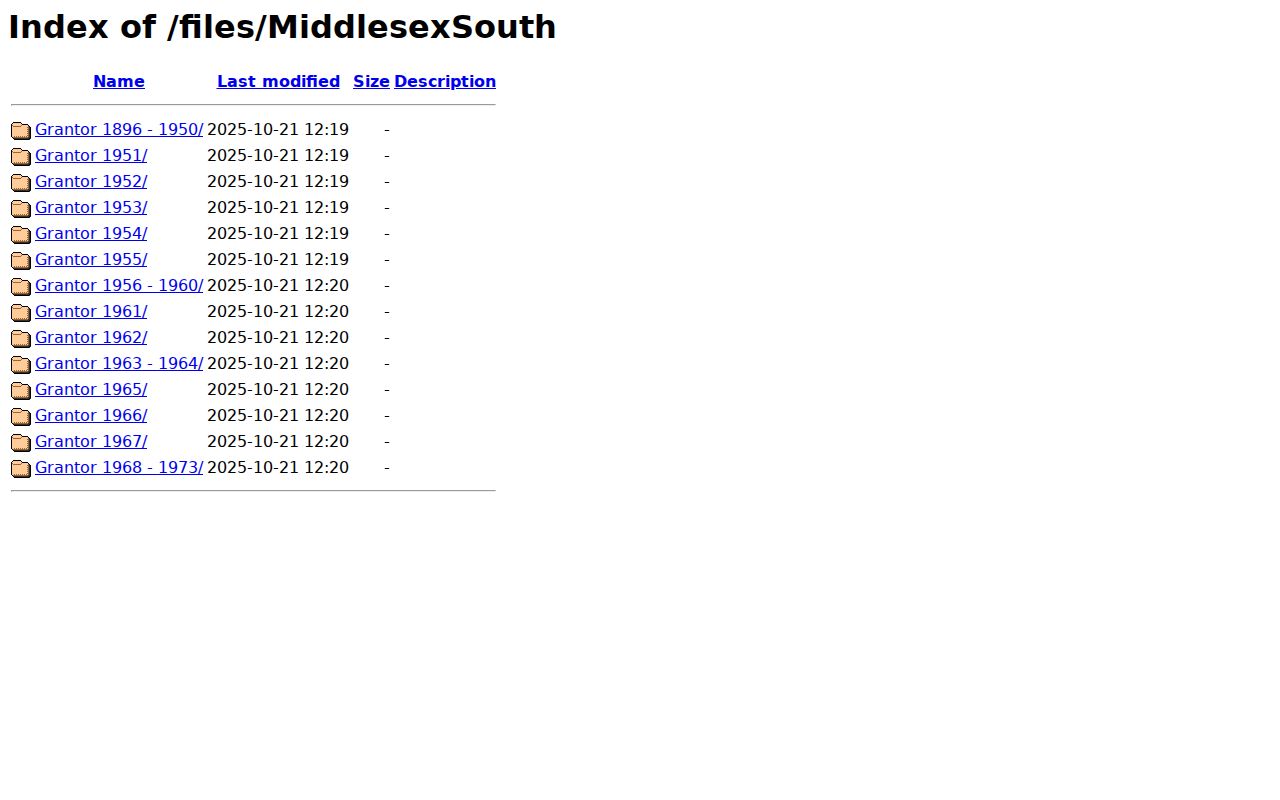
The folder structure is a route to historic name-side evidence, not a substitute for checking the related deed image and the parcel description.
Malden Previous Residents Map Years
The Malden Library's house-history method puts maps beside deeds instead of treating an address as fixed. The library has Sanborn copies in hard and digital form, and its local guide pairs them with the deed chain, directories, poll lists, newspapers, and a written timeline. The Library of Congress makes the 1904 Malden Sanborn available as a 66-sheet public-domain resource. The research record also establishes Malden Sanborn dates of June 1887, May 1892, July 1897, 1904, revised 1943 and 1951, 1957, and 1973.
- Begin with an informal architectural survey of the Malden property and the features that may help date it.
- Build the deed and chain-of-title sequence at the Southern Middlesex Registry.
- Compare Sanborn maps with poll lists and directories for occupants, occupation, and listing clues.
- Use the newspaper index and microfilm, then assemble a timeline of people and property events.
Use the Malden Library house-history guide to keep the local records in a sensible order.
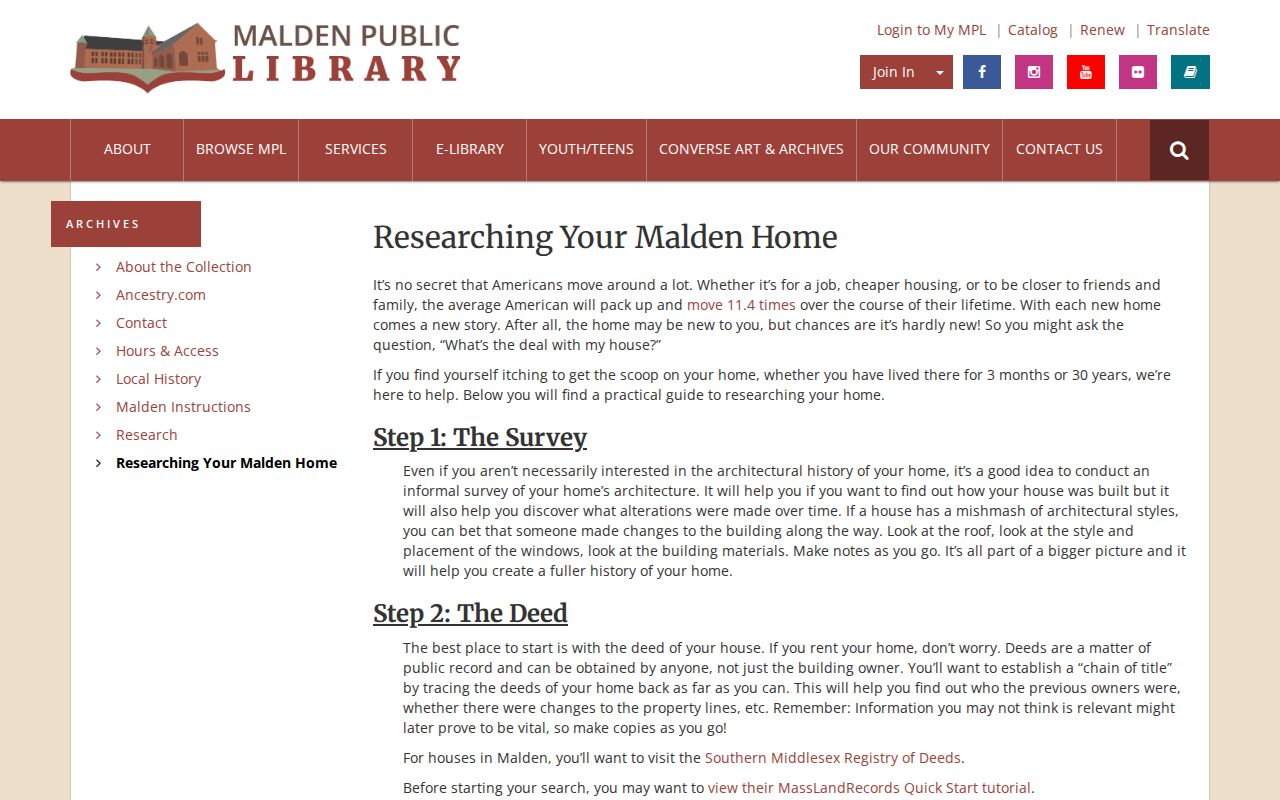
The guide directs researchers to assemble a timeline of occupants, fires, additions, wiring, and other events instead of making a conclusion from one document.
The 1885 and 1897 Walker atlases add lots, owners, buildings, rail lines, and street patterns. Compare them with the 1904 Library of Congress Sanborn map, current GIS, and the deed description when the lot or street arrangement is uncertain.
Malden Deed Index Limits
A current street number is not a guaranteed key to an older Malden record. Early city directories lack street indices, while poll-book street indices do not appear until the 1930s. The City street-index and tax-map material uses map numbers and warns that the deed controls the legal parcel description. Older Malden references can also be complicated by changing municipal edges shaped by the city's division from Melrose and Everett.
When a number fails, search the person name first, then compare the legal description, neighboring owners, ward or precinct order, printed street spelling, map lot, and old parcel information. Do not force a match because the modern address looks similar. A directory gap, changed street layout, rear parcel, or land-only parcel can break the apparent address trail.
Note: A map is a planning and reference aid; the deed is the controlling land description for parcel continuity.
Malden Previous Residents Household Trail
Owners and past residents are not always the same people. Once the deed chain anchors the lot, Malden's local directories, List of Persons, poll books, and census schedules can build the household layer. The List of Persons begins in 1884 and is organized by ward, precinct, street, and house number with an alphabetical back index. It covers people age 17 and older and can record occupation, birth year, and voting status. Polk directories begin in 1869, and their coverage and reverse-search features vary by volume.
Use the historical collections in a focused way: directory year to printed address, List of Persons or poll list to ward and street context, census to household composition, then newspaper material to test a move or death. The physical collections and their handling rules are detailed with the Malden city directories.
Follow this household flow: parcel and legal description → dated deed transfer → directory or List of Persons → nearest state or federal census → newspaper or obituary check → probate only if an estate event is supported.
See the Malden digitized archives for the companion visual collections.
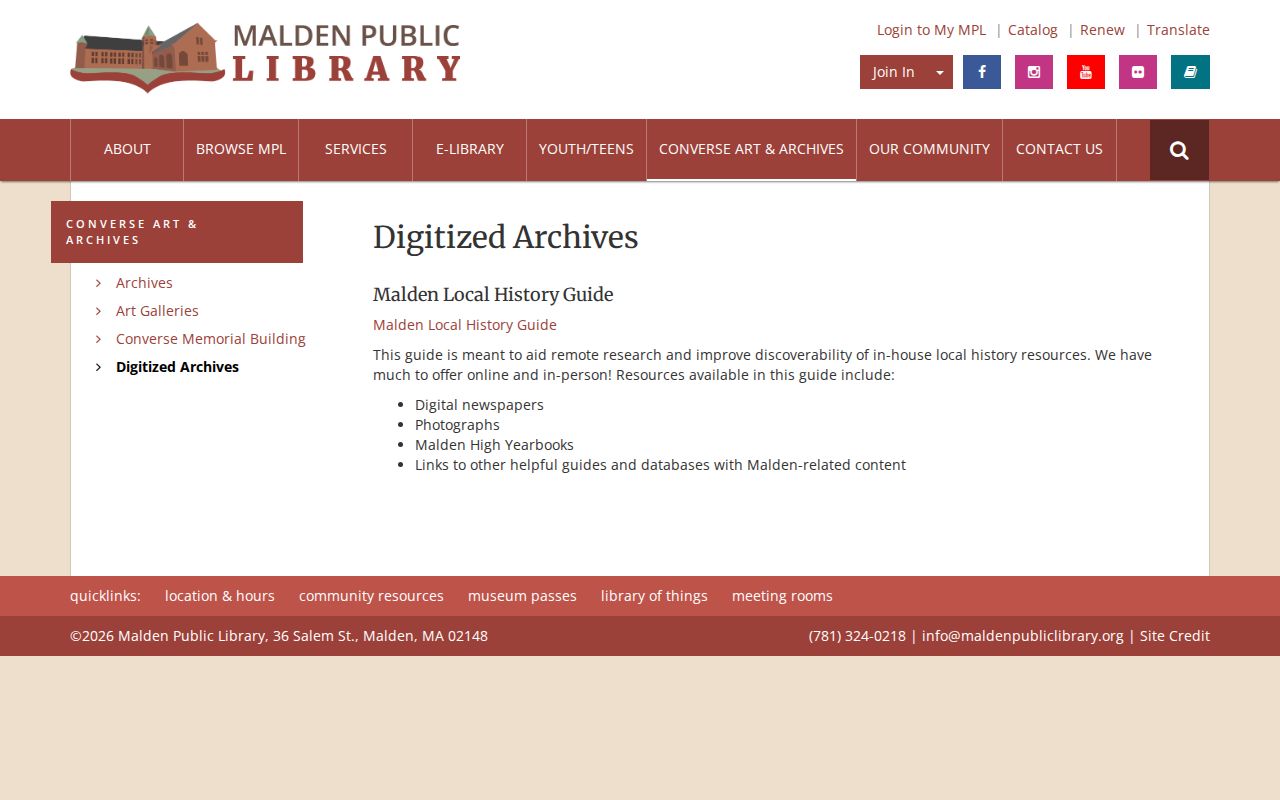
Maldonian yearbooks from 1919-2015 and Malden house-photo links can help test a school, address, or family clue beside the dated household records.
Malden Previous Residents Endpoints
A person who disappears from a directory may have moved, died, changed name form, or simply not been listed. The Malden Library's newspaper index spans 1860-2001 and its obituary index begins in 1973. Newspaper microfilm can locate death, marriage, home sale, organization, and address-change notices, while the library's cemetery material can support a deceased-person finding. These are historical leads and should be checked against the record appropriate to the event.
For an estate endpoint, search the decedent in MassCourts and then use the Middlesex Probate and Family Court copy process for a docket or record if it is open. Probate can identify a personal representative, heirs, and property transfers in an estate file, but it does not create a dependable present-day contact record. Historical probate may be available through court archives, FamilySearch, or American Ancestors as described by Massachusetts guidance.
Note: Confirm a death, estate role, or property transfer with the named custodian before treating a newspaper or index entry as final proof.
Malden Previous Residents Limits
Public sources do not expose every household or address trail. Confidential voter registrations, Massachusetts Address Confidentiality Program substitute addresses, restricted vital records, sealed or impounded court material, and protected motor-vehicle information can stop a search. A Massachusetts Public Records Law request under M.G.L. c. 66, § 10 can seek an existing city record when the correct custodian holds it, but it cannot require Malden to create a new list or override a lawful exemption. Birth, marriage, and death certificates are handled through the City Clerk or state vital-record channels, not the public-records request process.